Diary Pages 1980-90
 This article looks at diary entries accompanying my art work created between 1980 - 90. Whereas the art work under discussion is irrevocable, the journal lends itself to reinterpretation. In this paper the journal entries are layered with readings guided by seminal feminist writings. These ideas could not have been articulated as clearly when the paintings were first made. Feminist discourse was then little known in Jamaica.
The paintings referred to in the entries are not consciously feminist but their imagery is gendered. With patterned and decorative surfaces they fit easily into a feminist genre. Their central theme is about female patterns and life cycles, but no other methodology or guideline for interpreting them is obvious. To view this body of work from an entirely feminist perspective is erroneous, however, because they are the product of a complex set of social and personal factors.
The decade represented in the journal saw dramatic political and economic change in Jamaica. In the early 80s, certainly, debates about Democratic Socialism vs. Capitalism, International Monetary Fund directives, foreign exchange shortages, and especially pocket book issues of rice, flour and salt fish shortages, all had greater impact on the Jamaican publics' consciousness than Feminism.
 Artists engaged with all these issues. Jamaica's young, male, so-called 'avant-garde' artists such as Robert Cookhorne alias Omari Ra, Douglas Wallace and Stanford Watson, demonstrated their social awareness and tackled these realities through their painting. A loosely interpreted Marxism, black separatism and anti-Americanism held the greatest sway over the artistic imagination.
When women artists addressed social concerns in their paintings and sculptures, their imagery was less direct. Instead, it was allegorised and framed by nature. Their anxieties took the form of doorways (Merilee Drakulich View From the Study 1983), windows (Hope Brooks Window Series 1983), tunnels (Marguerite Stanigar Journeying 1985) and caverns (Laura Facey Hunters 1983) that seemed to provide escape routes into interior spaces, far from the cacophony of the outside world. The paintings discussed here fall within this genre of escapist imagery.
Since the excerpts are taken from a journal, the authorial voice, the subjective 'I', dominates in a way that might not be so prevalent in other texts. That 'I' represents a denial of 'otherness', the possibility of visibility , of existence outside the male domain, or, for that matter, within it. Yet, it is not used in a combative sense to distinguish the self from other women. Feminist writer Julia Kristeva recognised the use of 'I'...
"...this weird feminine seesaw... swings 'me' out of the unamenable community of women into single combat with another woman. It is perturbing to say 'I'. The languages of great civilisations that used to be matrilinear must avoid the use of personal pronouns: they leave it up to the context to distinguish the protagonists, and take refuge in tones of voice to recover submerged, transverbal correspondence of bodies." (1)
Yet 'I', written in the most intimate of settings, the female journal, might read more like 'we' in the recognition that there is commonality within women's experiences. If the art works appear shrouded in silence, however, it is because there was no clearly defined feminist movement in Jamaica during the eighties. Then, feminism was a luxury and 'female bonding' was not encouraged. That tacit code of silence that seems to be an inevitable aspect of middle class morality also pervaded the arts. Perhaps one visible manifestation of this was the prevalence of textured and collaged surfaces, visual poetry, graffiti, and layered surfaces that obscured the viewer from a clear reading of a paintings' content. This veiled imagery though enigmatic, was often little more than a smoke screen for disquiet. Many could read beneath the troubled surfaces, but we kept each others' secrets safe.
Gayatri Spivak has exposed the existence of class and race concerns within gender discourse. She suggests that American women dominate feminist issues, and their concerns are removed from the post-colonial realities of "Third World Women". (2). Certainly during the eighties in Jamaica, any Jamaican female artists who indulged feminist tendencies was seen to be following a marginalised fashion, imposed from outside rather than within our island politic. Feminism was read as being external to the more urgent needs that 'structural adjustment' within the Jamaican economy necessitated. Feminism was something one read about in magazines like Cosmopolitan, extraneous, frivolous, and alien to Caribbean culture that still enjoyed a strong matriarchal focus.
Class also dictated visual concerns. During the 80s, those women who managed to continue creating artwork despite economic hardships were usually from middle or upper class backgrounds where their financial contribution to a household was not essential. Women who fell outside this privileged category but still continued to be productive, managed to stay afloat by diversifying their work, by making it more commercially appealing, by creating craft items or by moonlighting.
So text, context and class need to be considered when deconstructing the diary entries that follow. My 'not so hidden' voice, is that of a thirty -something' woman, married, 'mothered' and divorced within the decade. I was middle class, career led, and, to a certain extent, privileged, since I continued to paint, despite certain hardships.
The following excerpts seem to follow a repeating pattern of death and rebirth. They begin within the shadow of marriage, at that time an unrecognised death.
March 1980
The Pattern
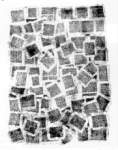
My interest, in the pattern began whilst I was still a student. Then, I had both time and freedom to paint. I selected my motif, a small square containing circles and triangles and went to work repeating it ten times, 100 times, 1000 times in innumerable combinations of the three primary colours , red, yellow and blue.
Essentially, I study the pattern as I paint it, from the small to the large, hence I begin with myself and move outward toward a more collective understanding. But it must begin with me, it must relate to me, it must be part of my reality and understanding. Otherwise I'm drifting. So as my life changes, as my awareness changes and develops, so too the pattern, grows and becomes all embracing. I strive for an understanding of the pattern inside and outside.
My days are quiet, long, and uninterrupted, my work is intense, disciplined, well ordered and ambitious. I set myself a challenge and paint giant canvases covered with this tiny motif. Through working in this manner, I come to understand the other side of the spontaneous creative act, that which occurs at the end of a long and disciplined road, and I love it. I don't just love it, I thrive on it, because that pattern rests me, it orders me. I become it, I personify it. I am pattern, disciplined, orderly and ambitious.
And then life changed...
June 1981
Patchwork: The Female Pattern
Patches, memories, pencil, paper
Fabric dinner working being
Kodachrome clicking touring antique
vintage drawing together coffee
bacon, onions classroom spareribs
library loving staying hiding
striving wanting failing winning
Dinner knowing Canvas cabbage
corn beef wine pushing needing
Toast Ice cracking breaking
Friendship making Dying frying
sunsets, winning, wanting
cleaning sweeping brushstrokes
tightening intense Pattern motif
living patches...
The initial step was to move that little bit more outside of myself and understand the pattern not just as it applied to me but as it applied to all women. I was functioning as a married woman in a new domesticated lifestyle and I threw myself eagerly into the role of housewife. Slowly I came to see that the female pattern was essentially a patchwork, a piecing together of different facets of life in order to achieve a harmony, a balance.
Only then, could I fully appreciate the peculiar nature of women's creativity and the way we develop forms from the small to the large. Previously, I had observed this in my own pattern-making, eventually I came to see this process reflected in other 'craft ' forms. In the convenient piece of crochet, knitting or sewing taken out at odd moments ,or at the end of a long and tedious day.
In my case, my canvases became smaller, drained of colour, pieced together gradually, falteringly, edging their way towards completion. Like a patchwork, it was disciplined work achieved stitch by stitch and for me, it had as much integrity as other art forms such as a still-life in oil paints or a water-coloured landscape.
Patchworks like so many other creative art forms were traditionally derided. Yet, these 'crafts' gained my respect with the realisation that the patch signified more than a fragment of fabric in a quilt; it was the product of a lifestyle. I found a quote that seemed to summarise all this and I wrote it in my diary. "My whole life is in that quilt. All my joys and all my sorrows are stitched into these little pieces. I tremble sometimes when I remember what that quilt knows about me." (5/3/1983)
A patchwork quilt out of a patch work life. The patch work was taking place in reality. From waking in the morning, fixing breakfast, hurriedly preparing work, dabbing on cosmetics, jumping into clothes, working in the office. Or at home, preparing the baby, ferrying children to school, cleaning the house, washing clothes. Then, setting the table, preparing more food, scrubbing down the floor, shopping, studying, loving, tidying...all activities thrown together to form a patchwork life. I understood it well because I was living it.
I lived it and admired it and it was an achievement to accomplish so much in the course of one day, and visually my patchworks reflected that lifestyle. I was excited by them. Those scraps of material, the torn thought from a diary, clippings from newspapers, all neatly linked with thin black lines, the stitches, and the scratchings of a black ink pen. The act of repetition settled my mind. I was lost in this ordered world. I took comfort in my little patterns. I was content to humble myself to it.
But slowly the spell began to break. I wanted to give this female work its proper status, venerate it and expose it. Yet, as I worked with the pattern, I talked to people, I read, and I considered why the patchwork had to be so fragmented in its execution. I started to resent it. I began to hate it.
I became angry.
There were things I had not even touched on; the economic factor for instance: that this piecing together of fabric had come about essentially from the need for cheap covers; that patching together was done in an atmosphere of deprivation; that torn edges of fabric and the neatly controlling stitches were not to be considered aesthetically but rather as the result of an unjust economic system
There was the fact that the pattern differed according to the economic background of the person living it. There were the women who told me that they resented their patchwork lives, of never having time to pursue one goal or objective. And the other women who avoided the life altogether for fear of being trapped in domestication and the inability to create at will. Most importantly, there was the woman who helped me see that there was not enough great about this patchwork pattern to venerate. It was so small scale, it was the imposition of a lifestyle, the stifling of human potential.
And although I could still see the worth of the pattern, I came to see the patchwork as a distorted form, an ugly perversion.
"I still stand for the pattern. I still understand the function of the therapy of the patchwork, but I am becoming disenchanted, coming to see it as a sign of bondage and confinement. Each stitch is like another brick placed on the walls of a female prison. How many would break out of that prison and realise their true potential...?"
November 1984
Frayed Edges
If I could die
I wish I could
die with
Passion
Not lying
Dying, not seeping
away
Not unraveling
Not fraying at the
edges
let me die from
the intensity
let me burst
let my head explode
I don't want
to fray at the edges
Unraveling
Dwindling
Slip sliding away
And I harboured the anger, shored it up, because I wanted to use it, wanted to make it visual, give it an outlet. And I patched and pieced and patched together, but I also talked and seethed, and mumbled and even plotted.
And the patchwork for me was wearing thin. The energy beneath the surface of it was so intense that it would burst those seams. I was still tacking and stitching and patching and piecing, while my guts were spilling out quietly. The stuffing oozing out of corners where the stitching had broken loose. The threads were straining, the patchwork was living. Beneath the surface ... life almost like a chameleon effecting change. The surface was cracking... life peeling away a new skin... new pattern waiting to be revealed.
Helene Cixoux has couched the female struggle in terms of violence, yet she also recognises that this violence can be experienced introspectively, through the text which becomes an escape route. In this 'anti-land', truth is the only imperative she admits her anger and that she 'has always been at war'. (3)
I called the work Disquiet (1983) but what I really wanted to call it was 'don't fuck around' but that might have seemed gimmicky and most definitely out of character. But that is exactly what I meant and felt. It was a warning.
And I wasn't just talking about female concerns, I was talking about the patchwork school that I taught in, or the patchwork economy with its patchwork cars on patchwork roads that we all functioned in, . I could feel that we were living on the edge, that marginal concerns could become major ones, that the violence was right there, up front. Disquiet was both a warning and a threat.
In 1984, I became pregnant. In Stabat Mater, Julia Kristeva discusses the complex issues that exist around the maternal body. It is couched in terms of mystique, defies analogy, yet is the very space in which a new form of ethic 'heretics' is nurtured. (4) The sense of alterity I experienced during pregnancy directly affected my visual language, introspection and a sense of temporary invisibility smoldered in tinier and tinier triangles.
1984-5
Meditation Mats
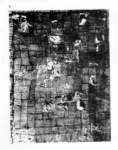
I don't know how and when the change was effected, but the evidence was there. Perhaps it was that period of nothingness that followed conception, when I created surfaces that just appeared to be 'on-going'. Those meaningless surfaces were filled with meaningless shapes. An action which became mechanical. Or perhaps, it was as a result of the waiting - an essential nine month wait before creation begins again. Looking back at these surfaces I don't know how I did them, how I captured the mundane. Yet now I read them anew. I see in them a resolve, a synthesis, and perhaps a personal leveling. I call them 'contained energy' - sometimes one work might appear volatile, but for the most part they are meditative.
I am at the point in the 'don't care' phase somehow detached from these strange works - curious myself about their 'mat-like' , 'window-like' formations wishing for someone else to apply the interpretations - offer the concepts - strangely drained - is this how other women feel when their creativity has been sapped? When the children, the house, the career, have had it all, one becomes depersonalised, the product, the offspring becomes the focal point and the self strangely recedes into the background. I look at these works and wonder who did them, what motivated the person to do them? But in the final analysis, I'm too tired to care.
It's difficult to pinpoint when the change came about and Meditation Mats with door-like entries suddenly gave way to Magic Carpets that I convinced myself could and would fly. The first was called Sweetest Taboo and I locked into it, a new found freedom. The dispelling of myth, the idea that one could do 'wrong', and that 'wrong' wasn't always 'wrong'.
Sweetest Taboo came in a rush. It was direct, colourful with an uncharacteristic clarity. It began the series, but it was the only one of its kind. As I settled to my Jamaican realities, my carpets that I so believed would fly, struggled for their power. I realised my flight was far from literal. My carpets provided for an inner journey- pure escapism- journeying to another country, another life in my head only.
I became obsessed with the shape inside the shape, inside the shape, journeying to the heart, revealing a little of what might reside inside, passion , hate, love, God whatever. The inward flight.
I am as yet uncertain about what I have found, reluctant to really look at the imagery. I find that I have created attractive surface - I suppose because in this fantasy world I have no need to acknowledge anger. Now I wait to show them and put them to the test. Will they fly for others as they have flown for me?
Painting like writing can invent new worlds, much of feminist theory has been built on the deconstruction and reconstruction of new realities. Cixoux writes, "If all my desire is possible, it means the system is already letting something else through. All the poets know that: Whatever is thinkable is real, as William Blake suggests". (5)
In 1986, I left Jamaica to study abroad. The Letters I Should Have Written series came about as a direct response to the dislocation I experienced as a young, black, single parent in England. Interestingly, the diary entry from this sojourn in a 'so-called 'first world' country, smacks of realities that I had never experienced in Jamaica. At home, despite political and economic constraints, one could still feel 'rooted' and 'protected', by virtue of one's status. England's realities were harsher, my status was ambivalent, more migrant than middle class.
October 1988
Letters I Should Have Written
Painting? ...For a long time I didn't...how could I? ...painting is after all a luxury and for nearly three years there was no room for luxuries in my life... in fact I had died...no.. my imagination had died... the rest of me still functioned, it had to. Those years were about survival, hand to mouth living. I vaguely attempted a series of monoprints called Letter I Should Have Written, and although the title was poetic enough, there was no room for poetry in my expression. The frames were filled with stilted, stifled imagery. They would have been surface and superficial were it not for the push and pull tensions emanating from the forms. They were cheap and practical, they wreaked of my hardships.
Cixoux also talks about woman in terms of race; otherness is blackness and everything that is apposite to white. (6) Woman has been conditioned to see herself as the dark continent where men lose themselves, explore, and act our their fantasies. Being black and female in a 'white world' is a double negative that provides for self-consciousness. But recognition of one's otherness is just the first step, self love is the second.
October 1990
View From My Skylight
Then perhaps a year later, I received a gift of time. Four months in another country, in a village, in a house, in a room with a window that opened onto a sky, a skylight... and when I looked through it , I recognised that space...Wasn't it the same space where my triangles had dissolved into nothingness. Night after night, I lay there wanting to paint that nothingness - knowing that therein lay my inner soul. Eventually, tentatively, I started monoprinting images that bore tedious resemblance to everything I'd done before - so scared of the internal longing, I laboured the outer trappings, the door, the window frame, hinges and glazings... but the more I lay there, night after night, the more I came to understand the inner sweetness, the intoxicating calm of nothingness, the very poetry of my being. And so slowly I let go...
Strangely, its not over now. For, although I could not take those 'starry starry nights' back to London with me, since then in the rooms that I have slept, I have discovered my own skylight. Is it possible that somehow I have realised a dream?
Post-modern discourse has questioned the notion of the literary 'happy ending.' Certainly within feminist texts there has been a rejection of the fairy-tale ending where the princess is saved by a kiss. The journal's last entry in 1990 might suggest that self-discovery brings happiness, yet such a reading would be deceptive. What it provides, is a new measure with which to critique one's actions. Although I still treasure the view I found from my skylight, I have not painted since.
October 1996
References
1. Julia Kristeva, "Stabat Mater (1977) in The Female Body in Western Culture, ed Susan Suleiman, Cambridge, Mass. Harvard University press, 1985.
2. Gayatri Chakravorty Spivak, "Feminism and Critical Theory" (1985) in For Alama Mater: Theory and Practice in Feminist Scholarship, ed Paula A. Treichler, Cheris Kramarae, and Beth Stafford, 1985.
3. Helene Cixoux "Sortiess: Out and Out: Attacks/Ways Out/Forays (1975) in The Newly Born Woman, trans.Betsy Wing. English translation by Minnesota University Press, 1986. In French, La Jeune Nee, with Catherine Clement, Union Generale Editions, 1975.
4. Kristeva, op.cit.
5. Cixoux, op.cit.
6. Cixoux, ibid