 Curatorial practice is an essential feature of my professional life stemming from my earliest training under the tutelage of Chief-Curator David Boxer (Cornell, Class of 67') at the National Gallery of Jamaica in the early 1980s. In these heady days, when the Gallery moved into its purpose designed location with a permanent collection in its eighteen new gallery spaces, promotion of Jamaican art through exhibitions was uppermost. As a young professional and over the next 20 years, I worked my way up the curatorial ladder from being an education docent, curatorial assistant, research officer, and then guest curator, to the Board Directors where I have served on the exhibition committee since 2000. Taking part in this institution's development, I recognize the extent to which mounting exhibitions, cataloging, and publishing are at the heart of canonizing our national art form and I am fortunate to have contributed to this pioneering process. The professional raison d'etre of much of my curatorial work has been the development and promotion of our national culture and to a great extent it has informed the choices that I have made about exhibitions. Although these have been hand-picked and relatively few, they have all been significantly large projects with good catalogs, and each taking more than two years to execute. In this way I have built a small but nevertheless credible portfolio of shows that has helped to define Jamaican and Caribbean art.
My first exhibition Home and Away was mounted at the October Gallery in 1990 and explored work by 7 contemporary artists, Omari Ra (African), Leonard Daley, Petrona Morrison, Danijah Tafari, Rex Dixon, Milton George and Eugene Palmer. The exhibition was funded by Eddie Chambers through the New Institute of Visual Arts (INIVA) and was accompanied by a catalog featuring an introduction and essays on each of the artists that explored their relationship to the concept of home from their different cultural perspectives. Home and Away served to introduce British artists to a handful of Jamaica's most contemporary artists as well as acquaint artists such as Eugene Palmer and Danijah Tafari to Jamaican art viewers. From a curatorial point of view it initiated my mission of creating exhibitions that mediated between Jamaica and its international audiences. In many ways this was a landmark show since it was the first time that audiences abroad were able to see art art work from Jamaica arranged around a post-modern theme. It shifted people's expectations away from the idea of Jamaican art as 'exotic' previously informed through a limited exposure to Jamaica's self-taught tradition and the work of the Commonwealth Institute.
New World Imagery was the title of my second exhibition curated for the Hayward Gallery's National Touring Exhibitions at the South Bank Centre in 1995 that formed part of Britain's Africa 95 season.
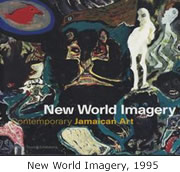 The exhibition, involved a conceptual framework built around the notion of the New World where issues of identity, for the eight artists selected, defined their art. Many of the artists had long since transcended these traditional racial and cultural categories of white-Jamaican, Chinese, African, but nevertheless for the sake of thematic presentation and the catalog essay, and most importantly the opportunity to show in some of the best galleries in Britain, they were revived.
The exhibition was a great success when it toured Britain in 1996, but my own failing as a curator were made clear to me, when the exhibition had a brief showing on its return to the National Gallery of Jamaica. Despite the slick packaging, I could not seduce the artists into accepting the post-modern veneer that obscured their thinking and their work. I was also forced to acknowledge that the exhibition's theme of cultural identity had been usurped by a kind of new labour vision of a multi-cultural Britain. For people in the Jamaica whose history of schism and rupture has led to a graceful accommodation of difference, New World Imagery was somehow redundant.
The converse can be said of my work on another exhibition Photos and Phantasms an exhibition of turn of the century photographs taken by the colonialist Sir Harry Johnston. When these works were discovered in the basement of the Royal Geograhical Society, the picture Librarian there, approached the British Council for support and funding to create this show. Because of the sensitive nature of the material, mainly images of poor rural black people in the Caribbean, it was decided to appoint a black curator. I happily took up the challenge unaware of how response to these works would engage me in a project that lasted almost three years. As I conducted research about Harry Johnston, I discovered more about his racist ideas, so much so that the British Council became wary of how a show of his work would be received as a Caribbean touring exhibition. In the end it was agreed that an extensive education programme should support the show, and as curator, I was asked to spend the next year and a half touring various Caribbean islands giving lectures and designing programs to explain Johnston's images. In spite of these measures each venue created new apprehensions, would Jamaicans known for their radicalism over race issues respond negatively to the images? In Trinidad there was concern that a show focusing only on black people might be frowned upon by the equally Asian society. For Haiti and Cuba, protocols had to be set up so that the activities of the relatively little known British Council could be introduced to the Spanish and French speaking Caribbeans. But all these concerns were ill-founded.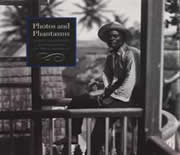 I now realise that much of the wariness towards the exhibition originated in the UK and seemed to be driven by guilt, and fear of reprisals for the past. These anxieties that were real to the British organisers did not translate for us in the Caribbean. Locals loved it. They welcomed its glimpse of the past. Caribbean audiences proved that colonial history was no longer taboo and that they were willing to talk freely about slavery, emancipation and blackness without rancour or hostility. History is so engrained in the Caribbean psyches that they have long since come to terms with its injustices and moved on.
Nevertheless my experiences of mediating between the two worlds of the Caribbean and Europe provoked my own 'paradigm shift' in my work as a free lance cultural agent: a necessary re-alignment to what is real in the Caribbean. In my own work this has resulted in a decision to shy away from block buster-exhibitions, to work more closely with individual artists, to write more for Caribbean readers in clear and accessible language and to avoid too many conferences. It has meant a down-grading of my transient, trans-cultural, transnational status and insidious air miles, in favor of observation and research and micro-management of issues that are Caribbean, and a whole world in itself.
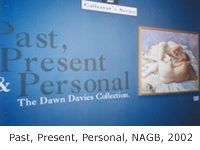
In recent years, I have spent a lot of time working as a consultant to the National Art Gallery of The Bahamas, a tiny nation of islands strung out along an archipelago in the Caribbean sea. Their art isn't great and its riddled with imagery typical of tourist resorts, but my work with them to build a National Collection, to develop of a skilled professional curatorial team, a vibrant community of artists and friends, an education center, and a program of regular exhibitions has been popular and successful because of a single condition; its policies and the development of the National Art Gallery of the Bahamas is grounded in, and relevant to the needs of artists, collectors and the wider Bahamian community. Bahamian art, its markets and audiences, like that of the rest of the Caribbean is flourishing because of its relevance to its people, because they see and recognise and confirm their identity through it. Both the One Man's Vision: The Vincent D'Aguilar Collection and Past, Present, The Personal: The Dawn Davies Collection were exhibitions and catalogues that explored the relationship of self to a Caribbean aesthetic.
It is becoming clear that globalisation is set to dominate the 21st century in much the same way that nationalism dominated the 20th century. As artists and theoreticians prepare themselves to articulate and situate themrselves within this new phenomenon, the issue of relevance becomes more acute, and it is important that artists and their communities share the same vision, even if it is expressed differently.
My most recent curatorial and research projects attempt to address these world trends. Back To Black jointly curated with Richard Powell and David Bailey for the Whitechapel Gallery initiated a three way conversation between the UK, USA and the Caribbean about 'blackness' in the 1960s and 70s. This major international exhibition including artists such as Romare Beardon, Ed Love, Aubrey Williams, Faith Ringold, David Hammons, Barkley L. Hendricks, and Betye Saar documenting their contribution to the black arts movement and its influence on the black racial imaginary. Working with multi-media including fashion, film, photography, print as well as painting, sculpture, music and album covers, the exhibition explored seven major themes including the ghetto; black popular culture; and politics.
In 2008, my research in Ethiopia selecting works from the archive of the Institute of Ethiopian Studies led to the symposium Ethiopia: Monarchy and Modernity organised jointly with Prof. Salah Hassan and Dr. Elizabeth Giorgis. Working with the Institute's collection we were especially interested in images from the past 125 years that portrayed Ethiopia’s march to modernity, its diverse culture including that of Armenian exiles, its rich imperial history and socialist revolution in 1976. In particular, portraits of the late H.I.M. Haile Selassie, the royal family, state functions and visits, offer a view of Ethiopia that is compelling and a stark contrast to contemporary representations of that region. The Emperor, Haile Selassie is undoubtedly the central figure in this archive, supported by a cast of family predecessors and forbears, who appear highly photogenic and sympathetic to the new technologies of photography. The family is captured in both formal and informal settings and provide insight into a life of ostentation and even glamor untypical of Africa in this period. For all these reasons, the archive is a national treasure that begs for the research and documentation that accompanies this type of project.
In the future, I hope that these research interests will funnel into a large scale exhibition entitled Rasta! to be hosted intitially at the National Gallery 2013 but with a touring component in 2014 that can serve the wider african diaspora.